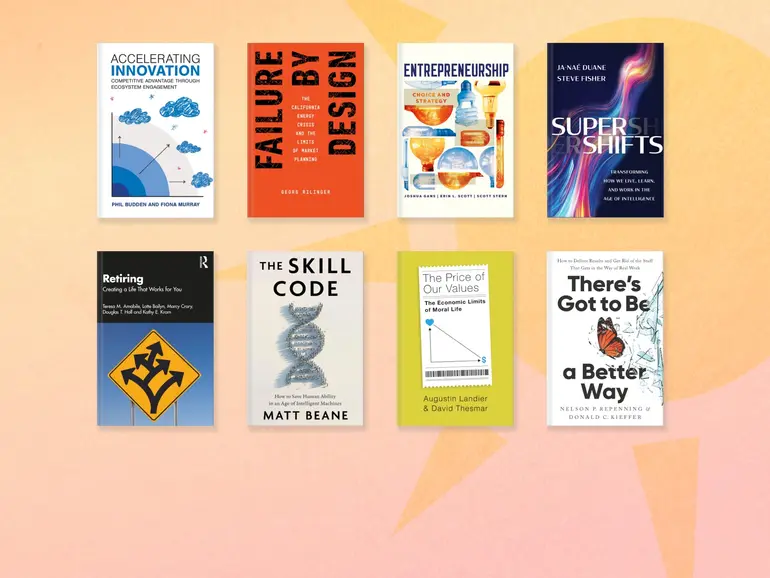
MIT Sloan’s 2025 summer book collection
Eight research-backed titles covering retirement transitions, artificial intelligence and skills development, and how to build an innovation advantage.
Faculty
Scott Stern is the David Sarnoff Professor of Management at the MIT Sloan School of Management.
Stern explores how innovation and entrepreneurship differ from more traditional economic activities, and the consequences of these differences for strategy and policy. His research in the economics of innovation and entrepreneurship focuses on entrepreneurial strategy, innovation-driven entrepreneurial ecosystems, and innovation policy and management. Recent studies include the impact of clusters on entrepreneurship, the role of institutions in shaping the accumulation of scientific and technical knowledge, and the drivers and consequences of entrepreneurial strategy.
Stern has worked widely with practitioners in bridging the gap between academic research and the practice of innovation and entrepreneurship. This includes advising start-ups and other growth firms in the area of entrepreneurial strategy, as well as working with governments and other stakeholders on policy issues related to competitiveness and regional performance. In recent years, Stern has developed a popular new MIT Sloan elective, Entrepreneurial Strategy, co-founded the MIT Regional Entrepreneurship Acceleration Program, advised the development of the Social Progress Index, and served as the lead MIT investigator on the US Cluster Mapping Project.
Stern started his career at MIT, where he taught from 1995 to 2001. Before returning to MIT in 2009, he held positions as a Professor at the Kellogg School of Management and as a Non-Resident Senior Fellow at the Brookings Institution. Stern is the director and co-founder of the Innovation Policy Working Group at the National Bureau of Economic Research. In 2005, he was awarded the Kauffman Prize Medal for Distinguished Research in Entrepreneurship.
Stern holds a BA in economics from New York University and a PhD in economics from Stanford University.
Read more about Scott Stern here.
Featured Publication
"Where is Silicon Valley?"Guzman, Jorge and Scott Stern. Science Vol. 347, No. 6222 (2015): 606-609.
Athey, Susan, and Scott Stern. Journal of Organization Design. Forthcoming.
Fazio, Catherine, Jorge Guzman, Scott Stern, and Weiliang Tang. In Elgar Encyclopedia of Entrepreneurial Ecosystems, edited by Catherine Fazio, Jorge Guzman, Scott Stern, and Weiliang Tang, Cheltenham, UK: Elgar. Forthcoming.
Agrawal, Ajay, Arnoldo Camuffo, Alfonso Gambardella, Joashua Gans, Erin Scott, and Scott Stern (Eds.). Cambridge, MA: MIT Press, 2026.
Agrawal, Ajay, Arnoldo Camuffo, Alfonso Gambardella, Joashua Gans, Erin Scott, and Scott Stern (Eds.). In Bayesian Entrepreneurship, edited by Ajay Agrawal, Alfonso Gambardella, Arnoldo Camuffo, Erin L. Scott, Joashua Gans, and Scott Stern, Cambridge, MA: MIT Press, 2026.
Gambardella, Alfonso, and Scott Stern. In Bayesian Entrepreneurship, edited by Ajay Agrawal, Alfonso Gambardella, Arnoldo Camuffo, Erin Scott, Joshua Gans, and Scott Stern, 63-84. Cambridge, MA: MIT Press, 2026.
Eight research-backed titles covering retirement transitions, artificial intelligence and skills development, and how to build an innovation advantage.
From MIT Sloan experts, practical guidance for launching ventures, shaping strategy, and making innovation work.
Through the 2010s the rate of new business formations was falling, triggering worries that the country's dynamism was fading. In 2020, professor Scott Stern and a co-researcher looked for a better measure. They took 28 million business registrations across 32 states covering 81% of US gross domestic product and asked how many of those firms ever amounted to anything. Only 0.07% reached an initial public offering or a meaningful acquisition within six years. More than a third of those came from the top 1% of firms they rated highest quality based on their characteristics the day they registered.
Artificial intelligence could transform the economy faster than any previous technology, and policymakers must move equally quickly to figure out how to respond, a group of economists and researchers are warning. The statement, titled "We Must Act Now,"was signed by nearly 200 people, including 15 Nobel laureates. MIT Sloan signatories are Institute Professor Daron Acemoglu, professor Sinan Aral, assistant professor Michiel Bakker, research scientist Christian Catalini, Professor Emeritus Bengt Holmström, professor Simon Johnson, professor Thomas W. Malone, professor Scott Stern, and principal research scientist Neil Thompson.
Publishing can give companies access to new ideas and recruits from academia, said professor Scott Stern. "They spill a little knowledge to get access to more. It's the ticket of admission to a scientific community they can draw from." Stern's work has shown that scientists are even willing to accept a lower salary for jobs that offer the freedom to publish and set their own research agenda.
"Clear and stable regulation arguably provides the right incentives for innovation."