MIT Sloan reading list: 7 books from 2026
New books this year from faculty members of the MIT Sloan School of Management cover AI ethics, startup finance, and AI’s impact on the work of the future.
Here are seven new books for your holiday gift list — or for yourself!
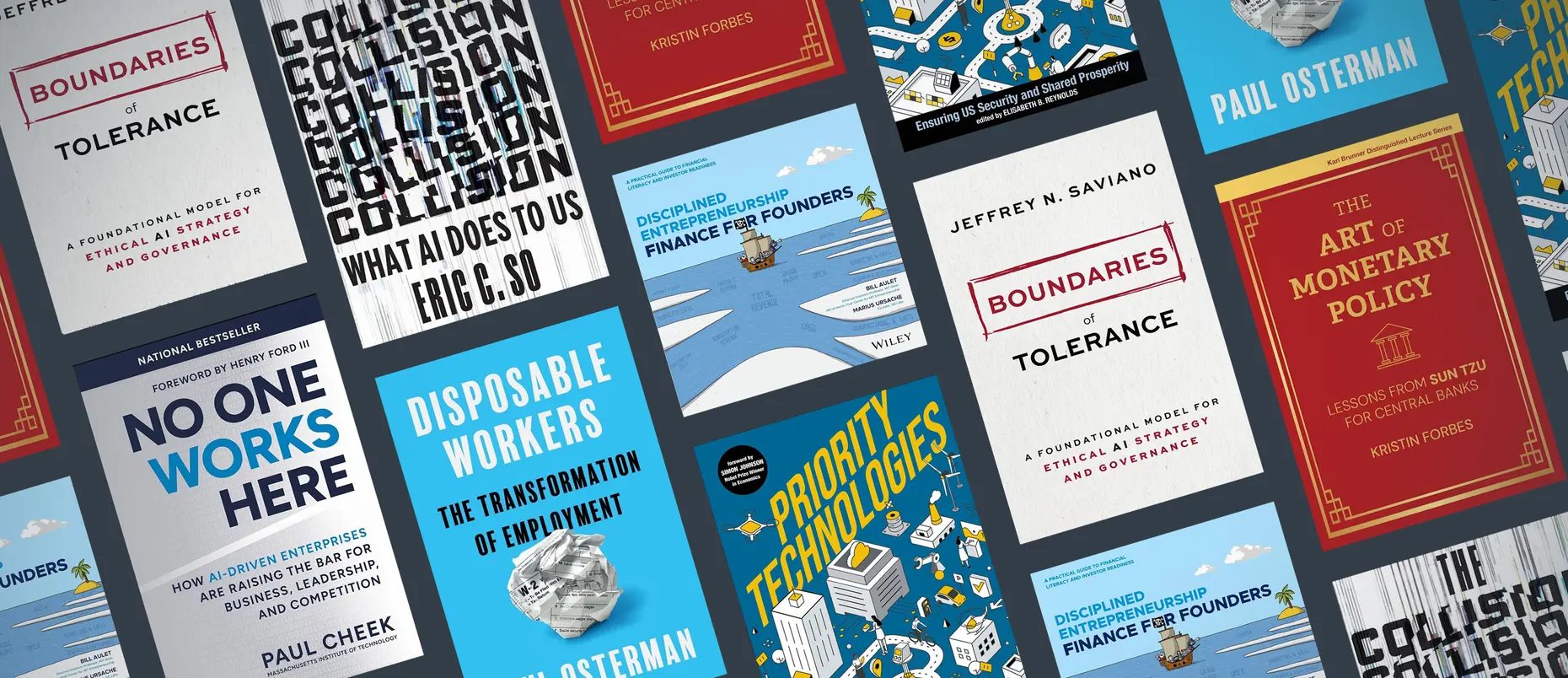
The Art of Monetary Policy: Lessons From Sun Tzu for Central Banks
MIT Sloan School of Management professor Kristin Forbes
Central banks are navigating a world of higher debt, tightly interconnected markets, and rising geopolitical tensions. How might they respond effectively?
In “The Art of Monetary Policy,” MIT Sloan economist Kristin Forbes draws on the writings of Chinese military strategist Sun Tzu to suggest modern principles for central banks.
Forbes extracts lessons from the last two tumultuous decades and uses these insights to provide suggestions for how central banks can improve their responses and support more resilient economies in the future. Priorities include preparing for the next financial battle, establishing a strong tactical position, combining weapons and methods, and modifying and varying tactics to maintain flexibility.
Boundaries of Tolerance: A Foundational Model for Ethical AI Strategy and Governance
MIT Sloan senior lecturer Jeffrey N. Saviano
Defining an ethical policy for AI is so difficult that some companies haven’t yet gotten around to it. MIT Sloan’s Jeffrey Saviano estimated that ethics and governance practices lag AI adoption by at least a couple of years. Yet “companies need to do the hard work to determine what they want to stand for in their AI programs,” Saviano has said.
Drawing on original research and years of advising boards and senior executives, Saviano developed his Boundaries of Tolerance framework to help businesses define their stance toward ethical AI. Included in the framework is a set of performance measures to help organizations assess their position on the AI ethics maturity spectrum and determine what’s required to advance to a higher level.
The book also includes case studies from JPMorgan Chase and practices from organizations such as Intel and the American Bar Association show how to embed values in AI systems and keep innovation grounded in integrity.
The Collision: What AI Does to Us
MIT Sloan professor Eric C. So
AI promises quick answers, but that convenience can come at a cost. In “The Collision,” Eric C. So, an MIT Sloan professor of global economics and behavioral science, argues that AI is creating two separate groups — those who use AI to think better, and those who use it instead of thinking, which poses a risk of cognitive atrophy.
“There’s a lot of evidence that when people get accustomed to working with AI, they lose their ability to function absent it,” So has said.
By drawing on research and examples of workers across industries, So shows that AI can erode understanding and encourage false confidence.
Readers will learn strategies to keep their brain fresh, such as:
- Embracing the struggle of solving a hard problem.
- Practicing structuring arguments on their own.
- Reallocating the time AI saves to solve harder challenges.
- Using AI to probe their assumptions.
Disciplined Entrepreneurship Finance for Founders: A Practical Guide to Financial Literacy and Investor Readiness
MIT Sloan professor of the practice Bill Aulet and Marius Ursache, DE Labs founder
When writing a book a decade ago, Bill Aulet noticed something that genuinely surprised him: Many brilliant founders were afraid of finance. In some cases, it even caused some businesses to fail outright. As a result, Aulet and Ursache decided to expand the Disciplined Entrepreneurship series to make finance accessible for first-time founders. Topics covered include:
- Demystifying financial statements.
- Building a financial model that produces meaningful projections.
- Presenting the results of your model to others.
The book addresses fundraising and valuation and tackles the mental and emotional barriers around finance so founders can focus on the more important parts of building a company. Interested readers can download three free chapters here.
Disposable Workers: The Transformation of Employment
MIT Sloan professor emeritus Paul Osterman
Companies cannot exist without workers, but they are increasingly reluctant to have employees. Instead of providing the benefits and protections that have traditionally come with employee status, businesses are turning to tactics that let them treat people as interchangeable parts, to be used and discarded as needed.
Drawing on an original survey of more than 6,000 workers, Paul Osterman, an MIT Sloan professor emeritus of work and organization studies, provides a revealing look at the decline in formal employment in favor of hiring contractors, freelancers, temps, and marginal workers who are excluded from traditional benefits and career ladders.
No One Works Here: How AI-Driven Enterprises Are Raising the Bar for Business, Leadership, and Competition
MIT Sloan senior lecturer Paul Cheek
Today’s knowledge workers are grappling with the “split-screen reality” of artificial intelligence in the workplace.
On one side are “AI-abled elite” employees who can move quickly, free from the administrative burdens of legacy organizations, writes MIT Sloan senior lecturer Paul Cheek. On the other side are legions of competent, diligent professionals still operating under the burden of a 20th century decision-making hierarchy while their career paths become less certain with each step.
In “No One Works Here,” Cheek makes a case for intentionally taking humans out of the loop when machines can make better, faster decisions. The result, he asserts, will be an enterprise that is no longer a hierarchy of people but a network of human and AI nodes.
In his book, readers will learn:
- Why the most dangerous metric in your company is the time cost of human involvement.
- Why managerial hierarchies are holding companies back, and how AI can help.
- How to build an AI-driven enterprise that runs while you sleep.
Priority Technologies: Ensuring US Security and Shared Prosperity
Edited by MIT professor of the practice Elisabeth B. Reynolds, with a foreword by MIT Sloan professor Simon Johnson
In a world upended by geopolitical rivalries, supply chain vulnerabilities, and energy threats, the global technological leadership of the United States is no longer assured.
What’s needed is domestic investment in technologies that are of strategic importance to the country’s national and economic security, according to MIT professor of the practice Elisabeth B. Reynolds, an expert in manufacturing and industrial competitiveness.
A new book Reynolds edited, “Priority Technologies: Ensuring US Security and Shared Prosperity,” lays out the strategic actions that underpin six important areas of focus: critical minerals, semiconductors, quantum computing, drones, and advanced manufacturing.
MIT Sloan senior lecturer Jonathan Ruane contributed to a chapter on quantum computing, and MIT Sloan professor Fiona E. Murray, co-director of the MIT Innovation Initiative, wrote about drones.
Bill Aulet is managing director of the Martin Trust Center for MIT Entrepreneurship and a professor of the practice at the MIT Sloan School of Management. He is the author or co-author of “Disciplined Entrepreneurship,” “Disciplined Entrepreneurship for Climate and Energy Ventures,” “Disciplined Entrepreneurship Finance for Founders,” and “Disciplined Entrepreneurship — The Revenue Engine,” among other titles.
Paul Cheek is a senior lecturer at MIT Sloan, senior adviser for entrepreneurship and artificial intelligence at the Martin Trust Center for MIT Entrepreneurship, co-founder and executive director of the AI-Driven Enterprise Institute, and founder of Entonomy. In addition to “No One Works Here,” he is the author of “Disciplined Entrepreneurship: Startup Tactics.” He received MIT’s Monosson Prize in 2025 for his impact on entrepreneurship education.
Kristin Forbes is a professor of global economics and management at MIT Sloan. From 2014 to 2017, she served as an external member of the Monetary Policy Committee for the Bank of England. She has also served as a member of the White House’s Council of Economic Advisers and as a deputy assistant secretary in the U.S. Department of the Treasury.
Simon Johnson is a professor at MIT Sloan, where he is head of the Global Economics and Management group. He is also a research affiliate at MIT’s Blueprint Labs and co-director of the James M. and Cathleen D. Stone Center on Inequality and Shaping the Future of Work. In 2024, Johnson, MIT Institute Professor Daron Acemoglu, and the University of Chicago’s James A. Robinson received the Nobel Memorial Prize in Economic Sciences “for studies of how institutions are formed and affect prosperity.”
Paul Osterman is a professor emeritus of human resources and management at MIT Sloan, as well as a member of the Department of Urban Planning at MIT. His research concerns changes in work organization within companies, career patterns and processes within firms, economic development, urban poverty, and public policy surrounding skills training and employment programs. His books include “Good Jobs America: Making Work Better for Everyone,” “Who Will Care For Us?: Long-Term Care and the Long-Term Workforce,” and “The Truth About Middle Managers: Who They Are, How They Work, Why They Matter.”
Elisabeth B. Reynolds is a professor of the practice in the Department of Urban Studies and Planning at MIT focused on systems of innovation, manufacturing, and industrial competitiveness in the context of national and regional economic development.
Jeffrey Saviano is a senior lecturer in AI strategy, governance, and ethics at MIT Sloan and recently completed a three-year research appointment at Harvard University. He leads the MIT Open Learning course, A New Imperative for AI Governance and Ethics: Winning the AI Race Without Losing Control.
Eric C. So is the Sloan Distinguished Professor of Global Economics and Behavioral Science at the MIT Sloan, faculty co-director of the AI Executive Academy, faculty chair of MIT Sloan’s PhD program, and lead faculty for the MIT Sloan Generative AI for Teaching & Learning hub. His current research portfolio spans interconnected topics, including artificial intelligence, behavioral economics, human-computer interactions, and regulatory policy. His book “The Collision: What AI Does to Us” is available now.
AI Executive Academy
In person at MIT Sloan
Register Now